

Construction & Infrastructure
Subcontractor qualification should be finished before mobilisation, not during it.
Contractors and infrastructure owners rely on chains of subcontractors, plant hire firms and specialist trades. Each needs insurance, safety documentation and financial standing confirmed, often for a specific project.
Supplier relationships
Who you onboard, and what you need from them.
Typical suppliers and documentation in construction & infrastructure. In Skuvet these become supplier categories with their own requirements.
Typical suppliers
- Subcontractors and specialist trades
- Plant and equipment hire
- Material suppliers
- Consultants and design firms
Information and documents
- Public and employer liability insurance certificates
- Health and safety policies and method statements
- Trade accreditations and licences
- Company registration, tax and bank details
The challenge
What makes onboarding hard in construction & infrastructure.

Insurance lapses mid-project
A certificate valid at award can expire before the work is finished. Tracking it in spreadsheets means the gap is found after an incident.
Each project re-collects the same documents
Site teams ask the same subcontractor for the same evidence on every new job because there is no shared, current record.
Approval sits with too many people
Commercial, safety and project managers all have a say, and nobody can see who is holding up mobilisation.
How Skuvet applies
An example onboarding workflow.
An illustration of how a construction & infrastructure organisation could configure Skuvet. Stages, checks and approvers are set to your own policies.
The subcontractor registers once and maintains a single company record.
Insurance, accreditation and safety documents are collected against requirements for the trade, with expiry dates tracked.
Exceptions, such as an insurance value below the required level, are routed to the reviewer responsible.
Commercial and safety approvals are recorded separately, so mobilisation is not cleared by one person alone.
Products and catalogues
Product onboarding is usually secondary here. Where material suppliers provide product data or declarations of performance, the same validation tools apply.
Supplier & vendor onboarding →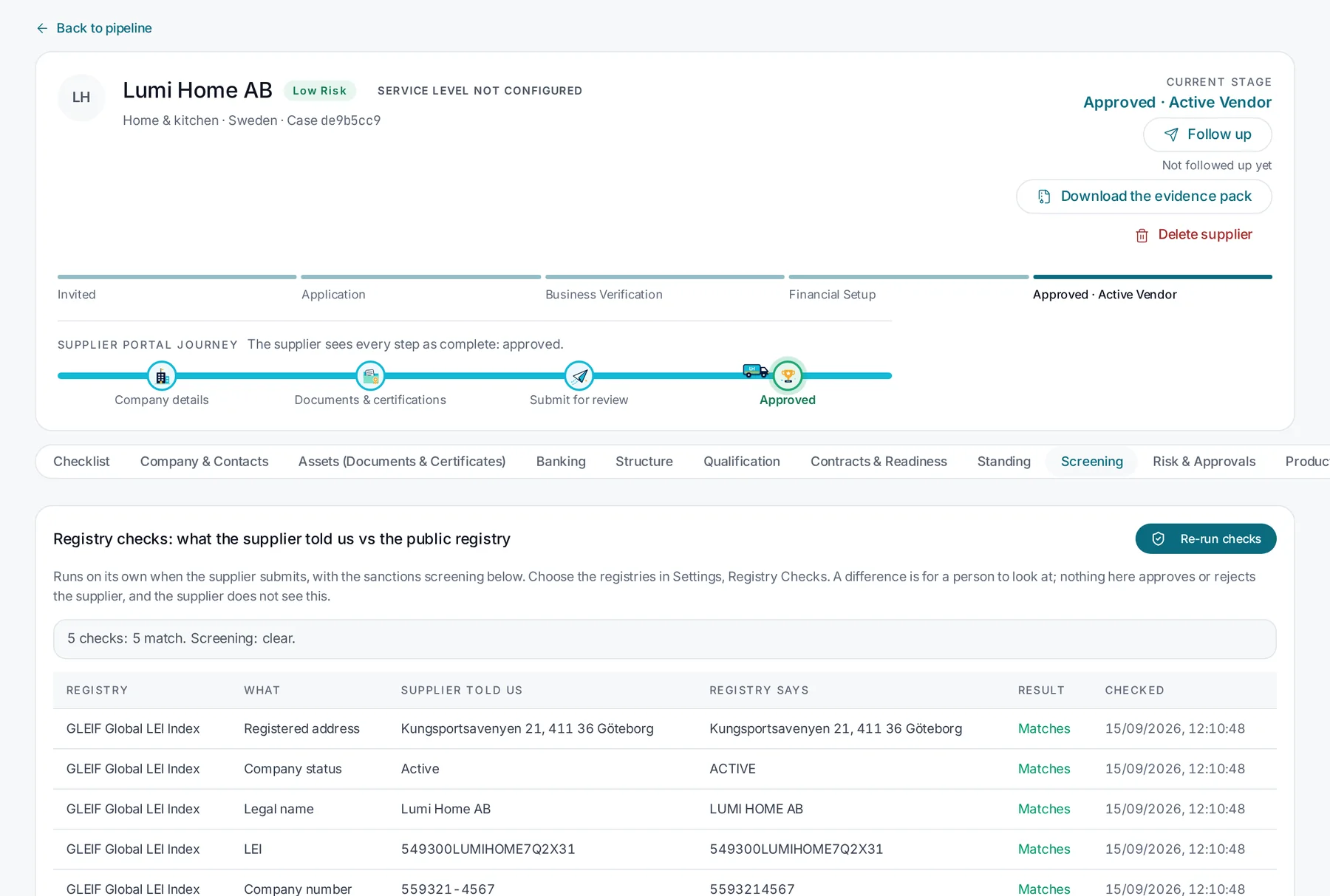
Requirements such as specific prequalification schemes vary by country and client. Skuvet can collect and track the evidence; it does not issue prequalification itself.
Other industries
The same platform elsewhere.

Banking & Financial Services
Third-party vendors under regulatory scrutiny, with evidence that must stand up to review.

Healthcare & Life Sciences
Suppliers of regulated products and services where traceability is not optional.

Technology
SaaS vendors, contractors and resellers with security and data protection obligations.
Experience Skuvet
See how Skuvet would work for construction & infrastructure.
Tell us about your suppliers, documents and systems. We will tailor the demonstration to your process.