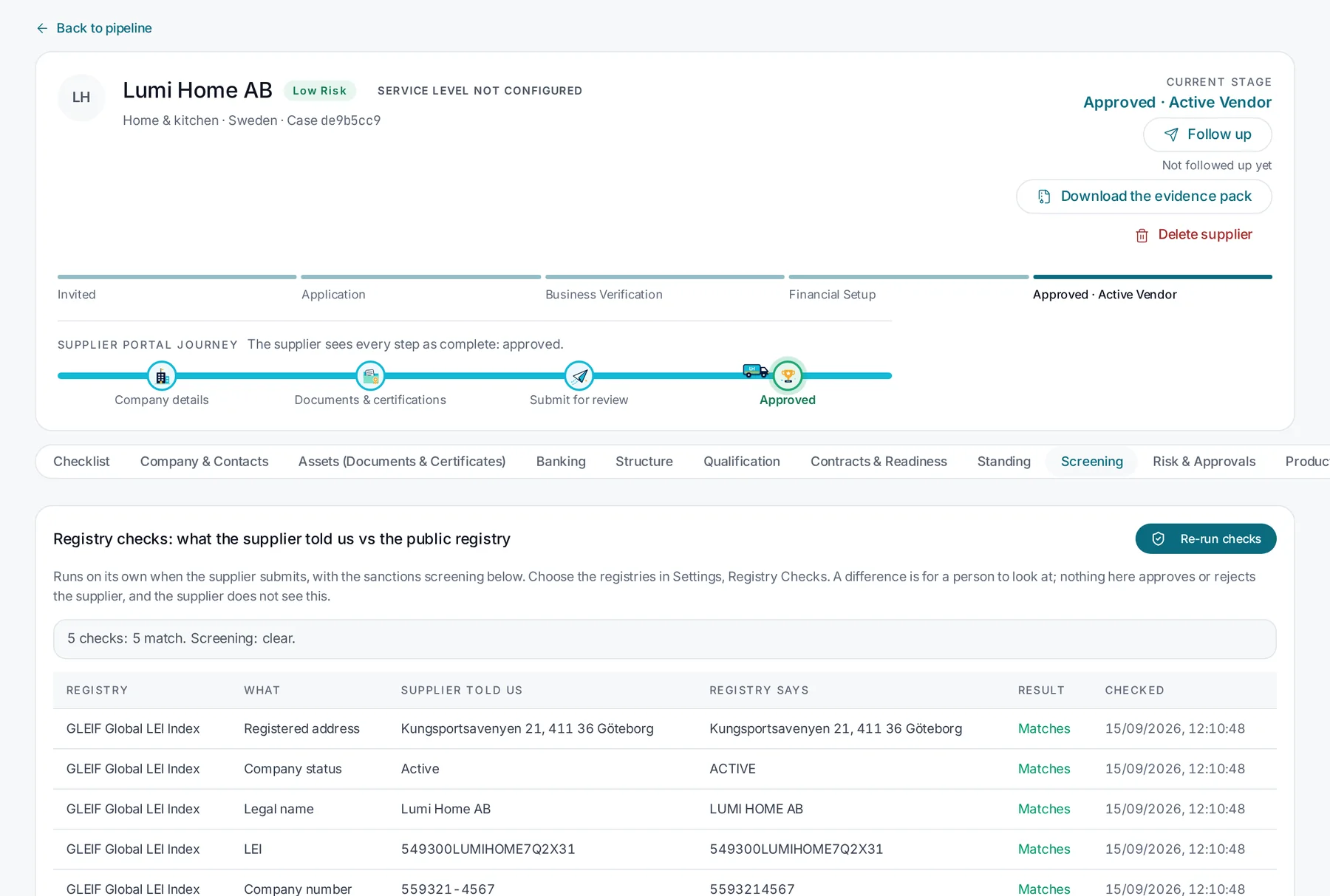

A common worry about automating supplier verification is that it removes accountability. If software checks the registry, compares the bank letter and screens the sanctions lists, who is responsible when something goes wrong?
The answer should not change: the person who approved the supplier. What changes is the information they have when they decide.
What automation changes
Without automation, a reviewer spends most of their time on mechanical work. They open documents, look up registries, compare names and dates. Judgement is applied at the end, often when the reviewer is tired of the case.
With automation, the mechanical work is done first. The reviewer receives a case where the routine checks have passed or failed with evidence attached, and their attention goes to the items that need it.
That is a better use of judgement, not a replacement for it.
Where judgement matters most
Near matches. Registries and documents rarely match perfectly. “ABC Holdings Ltd” and “ABC Holdings Limited” are the same entity. “ABC Holdings Ltd” and “ABC Holding Ltd” might not be. Software can flag the difference. A person decides what it means.
Context. A recently incorporated company is not automatically a risk. A recently incorporated company supplying a high-value category, with a bank account in a different country, may deserve a closer look. Context like this is hard to encode as rules.
Exceptions to policy. Sometimes the business needs a supplier who does not yet meet every requirement. Deciding to proceed with conditions is a judgement call that should be explicit and recorded.
Disagreement with the software. Automated checks will sometimes be wrong. A reviewer must be able to override a finding, and the override must be recorded with a reason.
Designing for good judgement
A few practical principles help reviewers make better decisions:
- Show the evidence, not just the verdict. A green tick is less useful than “matched against registry X on date Y, registered name Z”.
- Separate confident from uncertain findings. Reviewers should know where to focus.
- Require reasons for overrides and exceptions. This is good governance and it also improves the policy over time.
- Keep the decision with a named person. Group approvals are fine. Anonymous ones are not.
Accountability in the record
The audit history of an onboarding should tell the full story: what the supplier submitted, what checks ran and what they found, what the reviewer decided and why. In Skuvet, automated findings and human decisions are recorded together, so the record shows not just the outcome but the reasoning behind it.