
Ask an organisation what vendor onboarding costs and you will usually get a blank look. There is no onboarding budget. There is no onboarding team. The work is real, but it is distributed across people whose job titles say something else.
That distribution is the reason the cost stays hidden, and also the reason it persists.
Where the work actually goes
A single onboarding typically touches several functions:
- The requester in the business who needs the vendor and who chases progress.
- Procurement who checks commercial terms and whether a preferred supplier already exists.
- Finance or accounts payable who validates tax and bank details before payments can be made.
- Compliance, legal or risk who reviews sanctions screening, ownership and contracts.
- Specialist reviewers such as quality, health and safety, or information security, depending on what is being bought.
When each of these steps is run by email and spreadsheet, the time spent is not on the review itself. It is on finding the latest version of a document, working out who is waiting for whom, re-keying information into another system and answering the requester who wants to know where things are.
Four costs that rarely get counted
Coordination time. Every handover involves a message, a check and often a reminder. Multiply that by the number of reviewers and the number of new vendors each year and the effort is substantial, even though no single person feels it as their main job.
Rework. Incomplete submissions are the norm, not the exception. A missing page in an insurance certificate, a bank letter that does not match the registered name, a tax number in the wrong format. Each one creates a loop back to the supplier that can add days.
Exposure. Fragmented processes create gaps. A vendor gets paid before bank details are verified because the business was in a hurry. A sanctions check is done once at onboarding and never repeated. These are not process failures anyone chose. They are the natural result of a process nobody owns end to end.
Audit effort. When an auditor asks why a supplier was approved, the answer is assembled after the fact from inboxes and shared drives. The work of proving that a control operated can be greater than the work of operating it.
Why point fixes do not hold
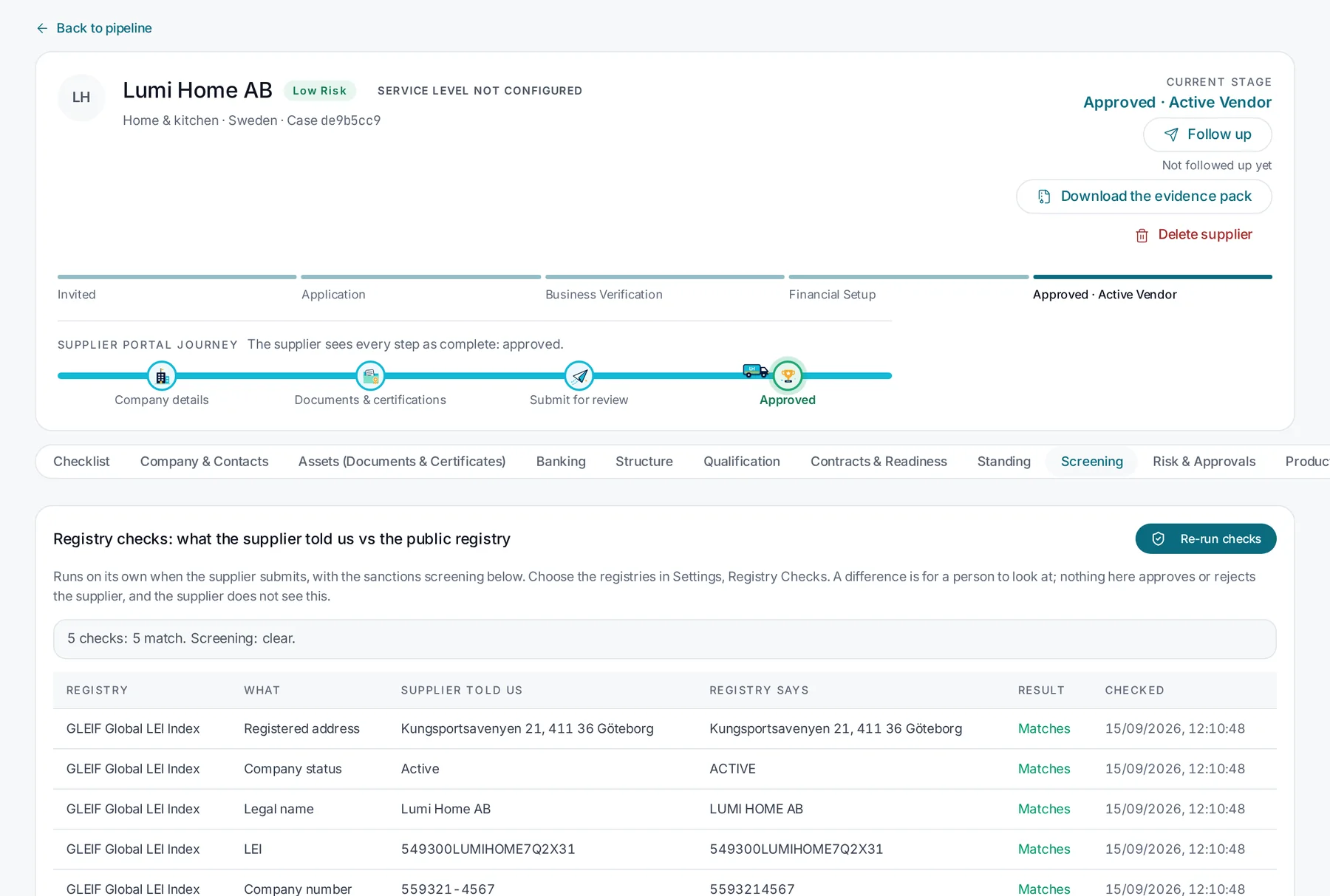
Organisations often respond with a better form, a shared mailbox or a tracker spreadsheet. These help locally but do not address the underlying issue, which is that there is no single record of the onboarding with a clear owner for each step.
A form does not route anything. A tracker depends on people updating it. A shared mailbox centralises the noise without reducing it.
What to measure instead
If you want to make the cost visible, start by measuring a small number of things consistently:
- Elapsed time from request to approved vendor, split by stage.
- The number of times a submission goes back to the supplier.
- The share of vendors with complete, current documents on file.
- How long it takes to produce the approval history for a given supplier.
These measures are hard to collect when the process is fragmented. That difficulty is itself a useful finding.
A connected record
The structural fix is a single onboarding record that every function works from: one place for the supplier’s submission and documents, one sequence of reviews with named owners, and one history of every decision. Software such as Skuvet provides this, and leaves the systems of record, such as the ERP, to do what they already do well.