
In most enterprises, a new supplier goes through two separate journeys. The first establishes who the supplier is: legal identity, tax registration, bank details, certificates, insurance, policies. The second establishes what the supplier sells: product attributes, classifications, images, safety documents, pricing and packaging data.
These journeys are usually owned by different teams. Procurement or vendor management owns the first. Merchandising, category management or a product data team owns the second. Each has its own tools, its own forms and its own idea of when the work is done.
Where the separation shows up
The cost of running them separately is rarely visible in a single place. It shows up as friction spread across several.
The supplier is asked for the same information twice. Contact details, company identifiers, country of origin, certifications and contacts for technical questions are often collected once for vendor setup and again for product setup.
Product work starts on a supplier who is not yet approved. Category teams eager to launch a range begin collecting product data while verification is still under way. If the supplier fails a check, that work is wasted or, worse, the products are already in a system downstream.
Approved suppliers sit idle. The reverse also happens. A supplier is approved, but nobody tells the product team, so the supplier waits weeks before anyone asks for a catalogue.
Compliance evidence is split. A supplier-level certificate, such as a food safety or quality management certificate, is relevant to every product it covers. When supplier documents and product records live in different systems, nobody can easily confirm that a product is covered by a current certificate.
What a connected process looks like
Connecting the two does not mean merging two teams or two systems of record. It means giving them a shared record of the supplier relationship that both can work from.
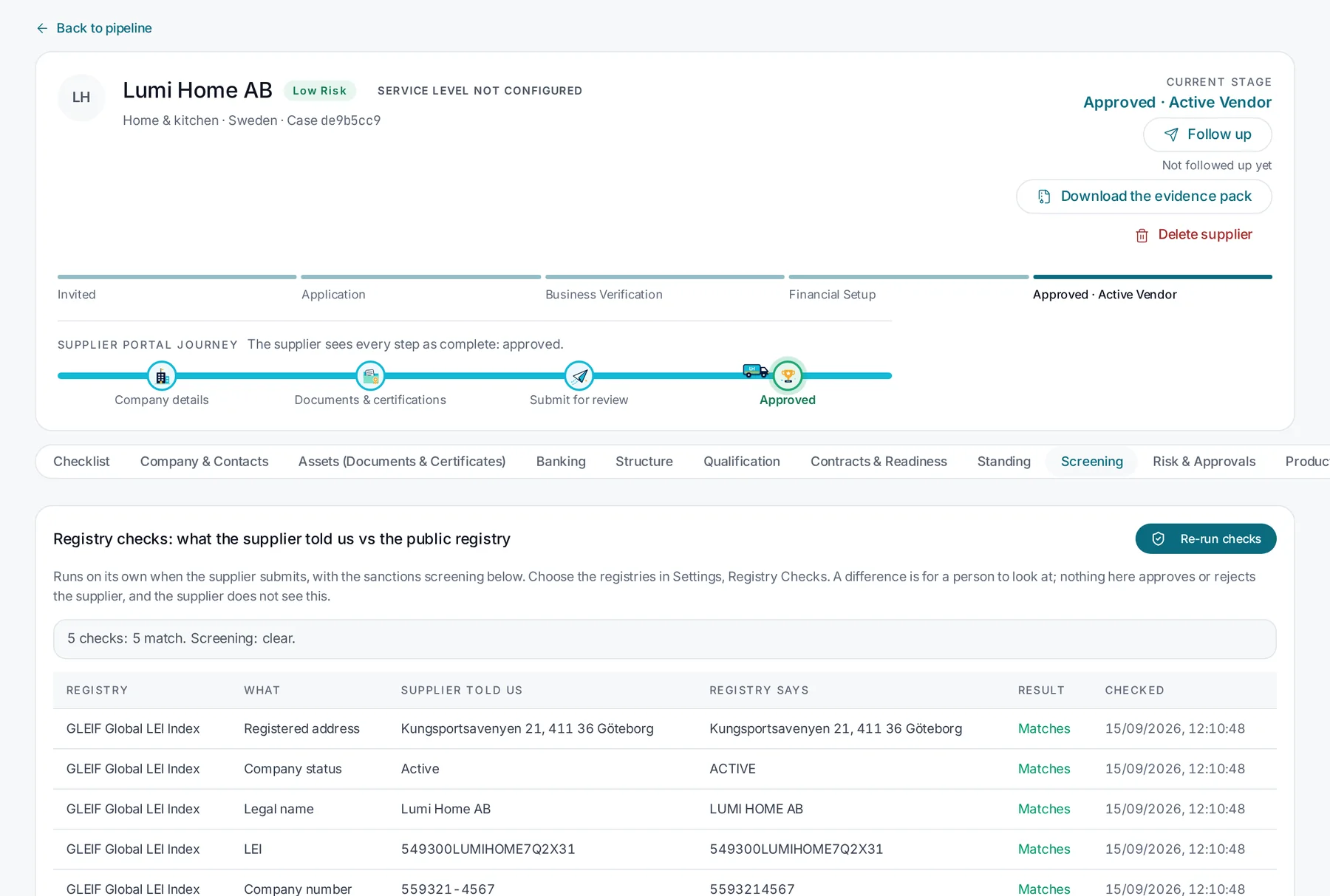
In a connected process, the supplier record is the parent. Product submissions sit under it and inherit its status. A supplier cannot publish products until it has been approved, and a supplier whose certificate expires is flagged in both views. Information collected once, such as identifiers and contacts, is reused rather than requested again.
The supplier experiences one relationship with the buyer rather than two unrelated portals. Internal teams see a single timeline from first invitation to first product live.
Questions to ask about your own process
- When a supplier is approved, how does the product team find out, and how long does that take?
- Can product data be submitted for a supplier who has not completed verification? Should it be?
- If a supplier certificate expires, which product records does that affect, and who would notice?
- How many fields do you ask suppliers for in both processes?
Where Skuvet fits
Skuvet treats supplier onboarding and product onboarding as one connected lifecycle. Product submissions are linked to the approved supplier record, and supplier documents remain visible when product records are reviewed. Approved data then flows to the ERP, PIM or procurement systems that remain the systems of record.
The principle is broader than any product, though. Whatever tools you use, design the two processes so that they share a supplier record, share status and hand over automatically. Most of the delay between “approved supplier” and “products available” is a coordination problem, and coordination problems are solved by design.